Robot companies in Germany: How to find the right partner for your logistics
The article highlights Germany as a robotics location and shows how to select the right robot company Germany for your logistics, production or service. He explains the differences between industrial robots, driverless transport systems (AGV), autonomous mobile robots (AMR), cobots, cleaning and service robots, and humanoid solutions. Practical examples illustrate how SMEs use EF Robotics to analyze their processes, select suitable robots and seamlessly integrate them to increase efficiency, scalability and safety. An expert tip from Ruwen Prochnow underlines the importance of process analysis before choosing a technology. EF Robotics positions itself as a vendor-independent consultant and integrator who supports its customers from planning to operation and creates sustainable, standards-compliant automation solutions.
Market overview and logistical challenges
The German economy is one of the international pioneers in robotics. Around 278,900 robots were used in industry in 2024 — four percent more than in the previous year. In 2024 alone, 27,000 new industrial robots were installed, making Germany a European leader. The figures show that robotics is no longer a niche topic. But for many medium-sized companies, choosing the right partner remains a challenge. The market is dynamic and heterogeneous: Large corporations such as Bosch, Linde Material Handling, Jungheinrich and KUKA dominate with broad portfolios, while specialized SMEs such as Agile Robots or igus shine in niches. More than 80 percent of the leading manufacturers are based in Baden‑Württemberg, Bavaria or North-Rhine‑Westphalia — regional clusters that also mean long journeys for decision makers.
Choosing a Robot company Germany depends not only on the product, but on the partner's ability to understand processes holistically. Many providers focus on one type of robot, such as driverless transport systems (FTS/AGV), autonomous mobile robots (AMR), articulated or linear robots. Others provide complete hardware, software and service solutions. In addition, the number of robots is becoming highly differentiated: In addition to classic industrial robots, collaborative robots (cobots), autonomous cleaning- and service robot as well as humanoid systems. For managing directors and logistics managers, this diversity means a strategic decision. The wrong choice leads to inflexible solutions, unnecessary costs, and security risks. This is where EF Robotics comes in: As a vendor-independent consultant, the company reviews the specific processes, layouts, IT systems and security requirements and develops individual concepts from them.
Definition of terms and market structures
Overview of robot types
- industrial robot: These stationary systems perform welding, handling or assembly tasks. The leading manufacturers in Germany include Bosch Rexroth, KUKA, ABB and Fanuc. Germany produced around 31,200 industrial robots in 2023, which corresponds to a market share of six percent worldwide. The increasing availability of cobots — i.e. robots that work right next to people — opens up new fields of application. Cobots already account for around ten percent of robot installations.
- Driverless transport systems (FTS/AGV): AGVs travel along predefined routes, which are often defined by magnetic strips or QR markings. They are suitable for fixed transport routes and have a high level of availability, but can only avoid obstacles to a limited extent. Safety sensors ensure stops in the event of unexpected obstacles. AGVs are ideal when processes are stable and layouts are not very variable.
- Autonomous Mobile Robots (AMR): AMRs use sensors, 3D maps, and artificial intelligence to react dynamically to their environment. They plan their own route and avoid obstacles instead of stopping at a band. As a result, AMRs are more flexible than AGVs and can also be used in tight, changing halls. Modern systems combine mobile platforms with robotic arms (Autonomous Mobile Manipulators) to transport goods and grab them at the same time.
- Service and catering robots: In the catering and hotel industries, robots perform serving tasks, transporting dishes and simple guest communication. Autonomous cleaning robots are also used in industry and commerce and ensure a high level of cleanliness without human resources.
- Humanoid & Collaborative Robotics: Humanoid robots are similar to humans in shape, size and mobility. According to management consultancy Horváth, they could do more than 50 percent of manual work in areas such as warehouses and logistics take over. Collaborative robots relieve employees of repetitive tasks and can interact directly with people thanks to voice recognition and gesture control.
AGV vs. AMR
The most important difference between AGV and AMR lies in the navigation method: AGVs follow predefined paths, while AMRs can choose free routes based on sensors and AI and avoid obstacles independently. AMRs are therefore ideal for dynamic environments and flexible processes. AGVs stand out for their simplicity and cost efficiency when operations are stable. For many companies, the question is whether a hybrid solution makes sense — such as fixed routes for incoming goods and flexible routes for order picking. EF Robotics analyses these requirements and suggests the appropriate system.
Programming and operation
It is becoming increasingly easy to operate modern robots. Visual no code platforms allow drag-and-drop programming. This reduces training time and also allows employees without in-depth programming knowledge to configure and adapt robots. Offline programming and simulation — often referred to as a digital twin — make it possible to create and test robot programs in a 3D model before the machine is in reality. This saves up to 80 percent of programming time and minimizes system failures. Simulation enables collision risks to be identified early on and robot utilization can be increased to up to 95 percent.
Safety and standards
The use of driverless transport robots and AMR is subject to strict safety regulations. In Europe, the EN ISO 3691‑4 and EN ISO 13849‑1 standards apply in particular to driverless industrial vehicles. These require safety zones, emergency stop functions and the validation of control systems. Safety zones that reduce speed or slow down when people approach are mandatory. EF Robotics takes these standards as well as the requirements of the Industrial Safety Ordinance and the DGUV regulations into account to make your operation legally secure.
Added value: advantages of robot companies in Germany
Efficiency and process reliability
Automation with robots increases productivity sustainably. Germany recorded a significant increase in robot installations in 2023:28,355 units sold represented a five percent global market share. Industrial robots ensure consistent quality, fast turnaround times and a measurable increase in workload. Mobile robots optimize material flow, reduce throughput times and prevent bottlenecks. By using cobots, manual and automated workstations can be flexibly combined, which ergonomically relieves employees and at the same time achieves a high level of process reliability.
Relief in case of staff shortages
The shortage of skilled workers is affecting many companies. Robots perform monotonous, physically demanding or dangerous tasks and create space for qualified tasks. In the metal processing industry, which achieved the best result since surveys began in 2024, robots are increasingly being used to compensate for staff shortages. Cobots support employees by holding welding equipment, handing out screws or taking on handling tasks. AMR take on repetitive transport tasks and thus relieve warehouse and production personnel.
Reduce costs through automation
While investments in modern robotic solutions may initially appear high, they pay for themselves through lower labor costs, higher availability and lower error rates. According to studies, the combination of offline programming and simulation results in a significant reduction in start-up times. The modular design of modern robots makes it possible to gradually expand systems and thus adapt the investment to the growth of your company — an advantage over rigid, monolithic systems.
Scalability and future-proofing
According to the Boston Consulting Group, the global robotics market is expected to reach a volume of around 260 billion euros by 2030. Companies that invest in scalable solutions today secure competitive advantages. Thanks to software updates and modular hardware, AMR can be adapted to changing processes. Humanoid robots are expected to take over many manual tasks by 2030. Flexible connections to ERP, WMS and MES systems keep your automation solutions fit for the future. EF Robotics therefore values open interfaces and standardized protocols.
Safety and cleanliness
Autonomous cleaning robots keep production and logistics areas clean, reduce cleaning costs and increase operational safety. Driverless transport systems and AMR work with certified safety controls and meet the required performance levels. They recognize people and obstacles and adjust their speed, preventing accidents and reducing accidents at work.

Robot company Germany in practice
To understand how a Robot Frma Germany A look at practice helps your company move forward. Assume that a medium-sized logistics provider in the e-commerce sector was struggling with increasing parcel volumes and long processing times. The existing conveyor belts were rigid, staff overloaded, and seasonal fluctuations led to irregular loads. Together with EF Robotics, the company analyzed the processes. Bottlenecks in incoming goods and in order picking were identified. EF Robotics developed a concept that combined driverless transport systems for main routes and flexible AMR in order picking. Thanks to digital simulation, layout variants could be tested in advance. After implementation, walking distances for employees were significantly reduced, processing times were shortened, and the system could be quickly adapted to peak days. Employees were helped with packing by cobots — they handed out boxes and did gluing work, while people could concentrate on quality controls. Management reports: “It was impressive to see how the material flow smoothed out and how quickly our team accepted the new systems. ”
RuwenProchNow's expert advice on partner selection
Define your process and specific use case first before you think about the technology. Process understanding is the basis of every successful automation. Ask yourself: What material flows exist? Where are bottlenecks? Which tasks are repetitive and can be standardized? Only when you have answered these questions should you select the appropriate robotics solutions. There is a great temptation to be guided by technical details or marketing promises. But one Robot company Germany Only really suits you if your solution exactly meets your requirements. We also recommend using pilot phases and simulations to minimize risks and involve employees early on. Training and a phased rollout increase acceptance and bring rapid results.
Technical criteria and integration approaches
Control systems and architecture
Modern robotics solutions consist of several levels: a reliable SPS/PLC level ensures real-time control and safe movements, while flexible software platforms based on ROS2 or other middleware systems perform complex tasks such as navigation, AI‑supported planning and image processing. This hybrid architecture combines the robustness of classic automation with the speed of innovation of open-source robotics. EF Robotics selects suitable controllers and integrates them into your existing IT landscape. It is important that interfaces to ERP, WMS or MES remain open so that data such as orders and inventories can be shared with the robots in real time.
Programming and simulation
Offline programming makes it possible to create robot programs without interrupting production. In the simulation, CAD models of the systems are loaded, robot paths are planned and tested without collisions. The programs are then transferred directly to the robot. This approach saves up to 80 percent of start-up time and increases availability to up to 95 percent. The OLP is supplemented by Visual‑No‑Code systems, which allow even inexperienced users to create workflows via drag-and-drop. EF Robotics uses both methods depending on requirements. An intuitive interface is often sufficient for simple pick & place tasks, while complex welding paths are simulated offline.
AI and sensors
Artificial intelligence will be the central technology of the next few years. It allows robots to learn tasks and adapt to new situations. Using machine learning, AMR is analyzing their environment and constantly optimizing their routes. Cobots recognize hand gestures and speech and can therefore interact safely with people. Sensor data such as LiDAR, cameras, 3D scanners and force-moment sensors are processed in real time. EF Robotics uses open software architectures so that new algorithms can be seamlessly integrated. However, AI‑supported optimization does not mean that classic control systems are becoming unnecessary: The PLC remains responsible for the safety logic. This clear separation ensures reliability and makes certification easier.
Safety and compliance with standards
Safety is not an optional feature, but an integral part of every robotics solution. The EN ISO 3691‑4 standard requires defined safety zones, emergency stops and redundant sensors for driverless transport systems. The risk assessment must be carried out and documented systematically. Powerful control systems with performance level d or e in accordance with EN ISO 13849‑1 are a prerequisite for operation near people. EF Robotics works with certified safety controllers and supports you in preparing the risk assessment and involving the industrial inspectorate. In addition, employees are trained so that they can use the systems safely.
Differences between standard robots and integrated solutions
Many manufacturers offer standard robots that can perform a wide range of tasks. In some cases, such a standard is sufficient — for example for simple pick & place tasks or palletizing. More complex processes require integrated solutions that combine robots, conveyor technology, software and safety concepts to form an overall system. EF Robotics creates a modular layout so that individual modules such as picking stations, packaging cells or cleaning robots can be flexibly expanded. Through independent advice, EF Robotics is able to combine manufacturers and systems and thus avoid supplier loyalty. The result is scalable, future-proof solutions that can be adapted to the development of your business.
How EF Robotics supports your project
Analysis & advice
It starts with a detailed analysis. EF Robotics works with you to record all material flows, process steps, layouts and IT interfaces. Experience shows that even small changes in process design can result in significant increases in efficiency. With the help of digital twins and simulations, various scenarios are played out before an investment is made.
Selection of suitable robotics
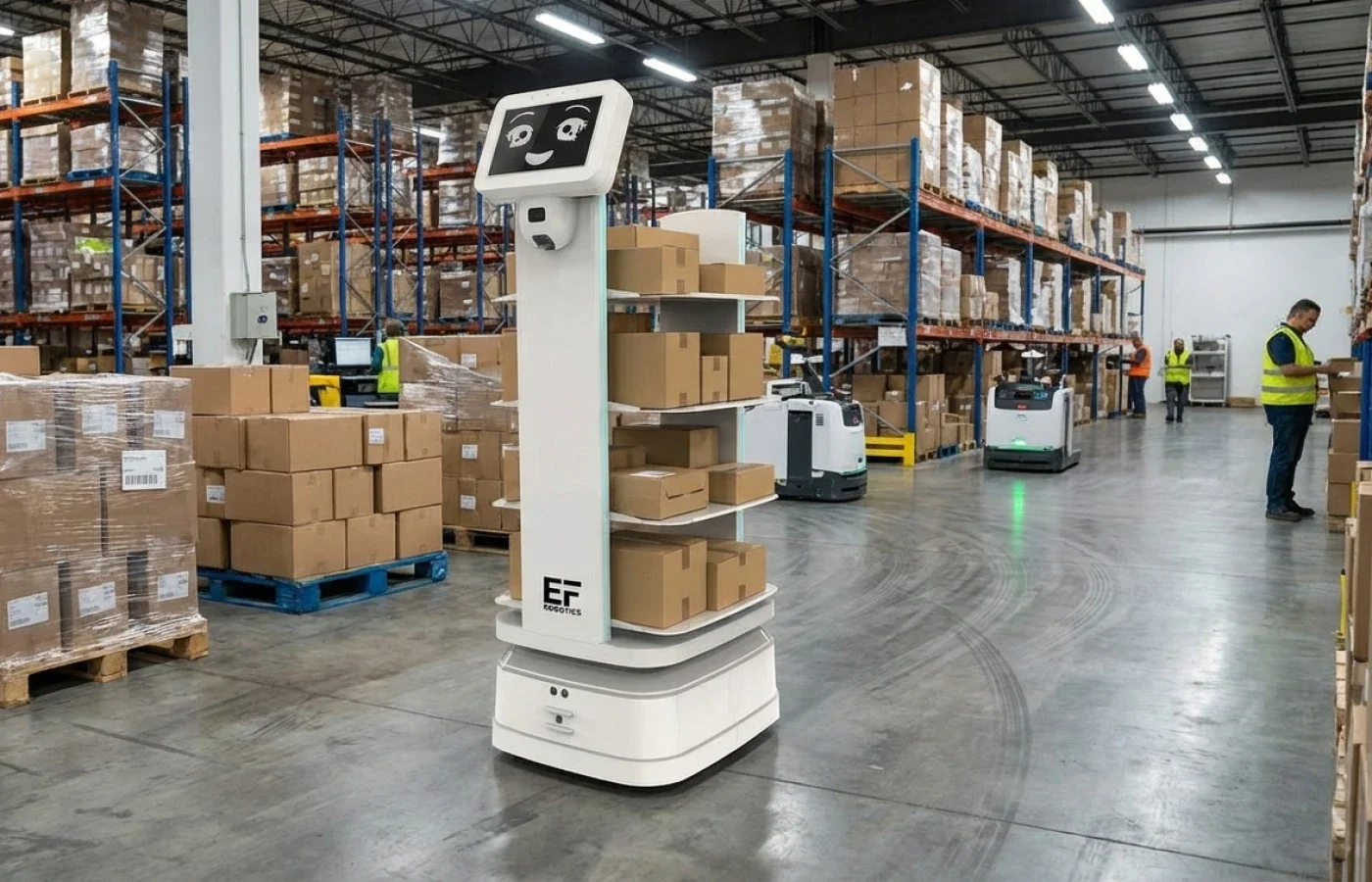
After the analysis, suitable systems are selected. Thanks to its vendor-independent position, EF Robotics can choose from a broad portfolio of industrial robots, cobots, AGV, AMR, autonomous cleaning robots and service robots. This takes into account whether a standard device is sufficient or whether a customer-specific design appears more appropriate. Criteria include payload, range, flexibility, software openness, security level and ease of maintenance. Particular attention is paid to the question of whether the robot can be integrated into existing systems or whether restructuring is necessary.
Integration into existing processes
The implementation includes not only the physical installation of the robots, but also integration with existing warehouse management and ERP systems. EF Robotics coordinates communication protocols and data structures so that orders are automatically transferred to robots. Mobile robots create routes, define safety areas and clearly regulate handover processes. Employees are trained to operate and an acceptance campaign is launched to reduce reservations.
Start-up, training & service
Successful integration is followed by commissioning. All safety functions are tested and ongoing operation starts in test mode first. EF Robotics supports on-site commissioning, optimizes parameters and comprehensively trains personnel. Long-term service is an important part of the business model: regular maintenance, remote monitoring and continuous software optimization ensure availability. Thanks to long-term partnerships, updates can be installed and new functions can be integrated. EF Robotics remains your point of contact when processes change or new requirements arise.
The wide range of Robot companies in Germany and the variety of robotics technologies make choosing a suitable partner a complex task. Germany is the European leader in the number of robots installed, while at the same time new providers are constantly entering the market. For decision makers, this means that only those who know their own processes in detail and understand the differences between AGV, AMR, industrial robots, cobots, service robots and humanoid systems can make a well-founded choice. As a vendor-independent consultant, integrator and long-term partner, EF Robotics offers the necessary all-round view. The company supports you from process analysis, selection and simulation to integration and long-term service. The focus is on profitability, scalability and future security. If you want to take advantage of the opportunities offered by robotics and are looking for a partner who combines technology with process knowledge, talk to us — we will analyse your use case and develop the right solution together with you.
We would be happy to advise you.
Our team has experience using robots in many areas. Make an appointment and we will be happy to advise you.
