Robot programming: methods, best practices, and how EF Robotics automates your processes
Robot programming is the backbone of modern automation. The article shows that methods such as teach‑in, offline programming, automatic programming and no-code solutions cover different requirements and complement each other ideally. Standards such as EN ISO 3691‑4 ensure safety, while hybrid architectures of PLC and ROS2 enable efficient control and AI. EF Robotics supports companies through analysis, selection, integration and service to make robotics projects economical, safe and future-proof.
Challenges and opportunities in robot programming
Industrial and service robotics We are currently facing two key challenges: Shortage of skilled workers and increasing demands for efficiency and flexibility. Many managing directors and plant managers are faced with the task of automating their production without jeopardizing ongoing operations and without access to a large IT team. The classic programming of robots For a long time, it was considered complex and time-consuming. Each customization project required deep code knowledge — a hurdle that prevented many companies from exploiting the full potential of modern robotics. At the same time, safety requirements strict: European standards such as EN ISO 3691‑4 and EN ISO 13849‑1 define strict rules for driverless transport systems (AGVs) and their control systems. For decision makers, this means that an economic solution must ensure compliance with these standards in addition to process optimization.
Core definitions and basics of programming
What is robot programming?
Under robot programming This means defining movement sequences, sensor data and control logic so that a robot safely performs a desired task. There are two basic categories:
- Online programming (teach‑in): The programmer uses the physical robot. It guides the arm to the desired positions manually or via a teach pendant; the system stores the coordinates. These methods include the classic Teach-inprocedures as well as playback approaches and direct parameter input via control panels. Observing the robot movement makes it easy to get started and requires only short training. As a result, one also speaks of Teach robots.
- offline programming (OLP): Here, the program is created externally on the computer. CAD data from the cell is loaded into simulation software, movements and processes are virtually tested, optimized and only then transferred to the robot. This eliminates downtime in production. The OLP enables deep interventions in the control system and the exchange or optimization of source code.
Robot programming methods
- Teach-in: The operator guides the robot arm manually or pendulum, and the software stores the positions. For easy handling in the service area, the movement pattern is repeated later. Advantage: low training costs. Disadvantage: time-consuming and inflexible, as every change to the physical robot must be learned.
- Playback: The robot is moved directly or via a model and then reproduces exactly this movement. Tremors or inaccuracies are interpolated by the control software.
- Parameter programming: Parametric inputs via PC or control panel define joint movements. This method is suitable for clearly structured tasks.
- offline simulation: 3D simulations make it possible to plan complex movements, identify collisions, and optimize paths. Digital twins connect the virtual model with the real cell through calibration.
- Automatic programming: Modern software automatically generates programs based on defined quality guidelines and CAD data. Studies show that OLP saves up to 80% of programming time and significantly reduces downtime. With automated OLP, employees without programming experience can create programs.
- No‑code and visual programming: Drag-and-drop interfaces allow you to create motion flows without code. Users configure blocks that assign actions to the robot. These approaches reduce learning costs and are ideal for collaborative and service robots.
AGV vs. AMR
Driverless transport systems are divided into AGVs (Automated Guided Vehicles) and AMRs (Autonomous Mobile Robots). AGVs travel on fixed routes, which are often specified by guidewires, magnetic strips or QR codes. They have low self-intelligence and stop when there are obstacles. AMRs On the other hand, use lasers, cameras and AI algorithms for free navigation. They create maps of the environment, recognize obstacles and navigate autonomously. This makes them suitable for dynamic layouts and can be quickly adapted without expensive infrastructure changes. Decision-makers should choose the technology that suits their own process stability: stable, linear processes benefit from AGVs; diverse intralogistics or catering from AMRs.
Benefits and benefits for decision makers
For managing directors and production managers, the economic efficiency of a robotics project. Choosing the right programming method has a significant impact on payback.
- Minimal downtime: OLP makes it possible to test and optimize programs on the PC while production continues. Virtual planning makes it possible to avoid collisions and reduce actual commissioning to just a few tests. Experience reports show that OLP requires up to 80% less programming time and increases robot utilization by up to 95%.
- Flexibility and scalability: No‑code systems and automatic programming allow adjustments within minutes. Employees without programming knowledge can create and adapt movement sequences. This enables a quick response to new products or seasonal fluctuations.
- cost reduction: Intuitive robot operation reduces training costs and dependency on specialized programmers. At the same time, process errors are minimized through simulation and automatic optimization, which reduces scrap costs.
- Relief for staff: AGVs and AMRs allow monotonous transport tasks to be automated. Thanks to intelligent navigation, AMRs can avoid obstacles and therefore work without interruption. Staff is freed up for higher-value tasks.
- Security and compliance: Compliance with EN ISO 3691‑4 and EN ISO 13849‑1 is mandatory. Redundant safety systems, defined warning and protection zones, and regular risk assessments ensure that people are protected. Emergency stop switches, protective fields, and lidar sensors prevent collisions.
Programming robots in practice
Case study: Intralogistics at a medium-sized manufacturer
challenge: A medium-sized machine manufacturer in southern Germany had to move up to 1,500 material containers between storage, production and shipping every day. Manual driving with forklifts led to delays, safety risks and high personnel costs. At the same time, there was no know-how to program complex industrial robots yourself.
solution: EF Robotics first analyzed the material flow data and defined the requirements together with the customer. Then were AGV robot programmed, which cover fixed routes to pre-assembly sites. For the variable part of the warehouse, additional AMR robot used. Most of the robot programs were created offline; only fine adjustments were made in teach‑in mode. Thanks to digital twins, collision points were eliminated and the control systems were able to PLC be integrated. The programming took into account all relevant safety standards (warning and protection zones) and enabled the robots to easily interact with existing conveyor systems.
upshot: The system was ready for use within twelve weeks. Material transport times were significantly reduced and operators were able to concentrate on assembly tasks. The plant manager reported: “Working with EF Robotics has shown us how important it is to have the right combination of offline programmed robotic logic and flexible AMR systems. After a short training session, our employees made adjustments themselves — this has significantly increased acceptance. ”
Customer voice
“We respected robotics because programming overwhelmed us. EF Robotics has given us a No‑code approach and let the robot be taught together with our team. After a few hours, we were able to adjust processes ourselves. Today, AGVs run around the clock and we can concentrate on our core competencies. ” — Production manager of a medium-sized logistics company

Expert tip from Ruwen Prochnow
“This is a tip that we always give our customers: First define your process and the specific use case before you select the technology. Without a proper analysis of material flows, security requirements and interfaces to your ERP or MES, you risk making expensive mistakes. We recommend using virtual simulations early on to see the impact of changes. Only when the process is stable do we select the appropriate robot hardware, control system and programming method. This keeps your solution cost-effective and scalable. ”
Technical details & integration
Programming languages and control systems
Industrial robots are programmed using proprietary languages such as URScript, KRL (KUKA) or RAPID (ABB). In practice, modern approaches combine various technologies:
- Robot Operating System (ROS2): ROS2 provides a collection of libraries for navigation, perception, and AI. It is suitable for applications where the robot must interpret the environment. ROS2 uses DDS middleware, which enables real-time communication. Since ROS2 is not designed for tough real-time requirements, it is usually used as a “brain” during the PLC takes over deterministic control as a “muscle”. PLCs are robust industrial computers that process logic in milliseconds and thus ensure safety.
- hybrid architectures: Many modern systems combine PLC logic with ROS modules. Vision sensors, AI algorithms and digital twins run in ROS2, while safety functions and motion control are embedded in the PLC. Decision-makers should pay attention to open interfaces to connect both worlds.
Security guidelines in programming
EN ISO 3691‑4 requires that AGVs must have at least two independent safety systems — a primary system for normal operation and a secondary system for emergencies. Safety zones must be defined: a warning zone reduces speed, a protection zone stops the vehicle immediately. EN ISO 13849‑1 lays down the Performance level d fixed; this means that the probability of a dangerous failure must be extremely low. Operators are required to carry out a risk assessment for every safety function and to arrange for regular tests. Germany has additional DGUV regulations; AGV systems must be inspected annually by specialists.
Automatic programming and no‑code
The development of automatic program generators is revolutionizing robotics. OLP software can independently create movement paths from CAD data and defined quality criteria. Users define tolerances; the software performs path optimization and collision testing. Advantages: program-free creation, reduced errors and quick adjustments. Together with drag‑and‑drop systems, this allows operators with no code experience access to robotics.
AGV and AMR integration
When integrating transport robots, decision makers must consider the differences between AGV and AMR. AGVs are suitable for consistent production routes. Their programming is based on fixed routes; obstacles are detected but the vehicles stop until the path is clear. AMRs are more flexible: They use SLAM algorithms and sensor fusion to navigate autonomously. In dynamic environments, they can avoid obstacles and choose alternative routes. For economic use, both systems should have a Fleet Management be controlled. This assigns transport orders by priority and allocates them efficiently.
Control systems and IT integration
An efficient robot solution is only as good as its integration into existing IT and control systems. EF Robotics uses open interfaces ERP, MES and warehouse management systems. In this way, orders can be sent directly to robot fleets and status data can be reported back in real time. Data interfaces such as REST APIs, OPC UA or Modbus TCP connect PLC controllers with higher-level systems. The following applies to safety functions: Emergency off signals and light barriers are connected to the PLC on the hardware side, while ROS2 modules for navigation and AI are protected by redundant safety channels.
Implementation with EF Robotics
Analysis & advice
EF Robotics Every project starts with a procedural analysis. Material flows, cycle times, safety requirements and layouts are recorded. The vendor-independent advice helps to objectively consider whether a Programming industrial robots, an AGV or an AMR is the best solution. In addition to Robotics programming alternatives such as process optimization and organizational measures have also been examined.
Selection of suitable robotics
Based on the analysis, EF Robotics selects from a broad portfolio of robots, controllers, and software. For Programming industrial robots Established brands (KUKA, FANUC, ABB) are just as suitable as new providers of collaborative robotics. In the case of transport solutions, AGVs or AMRs from different manufacturers are assessed. It is important that control systems meet the requirements and can be integrated into existing IT. Die Security guidelines programming are taken into account from the outset.
Integration into existing processes
Integration is iterative: First, the robot program is developed offline and tested with the customer in simulations. This is followed by Teachen the detailed steps on site. EF Robotics connects robot programs with PLC controls and ERP systems. Robotics control systems are configured so that emergency stop signals, sensors and fleet management work smoothly. The customer receives documentation that covers normative standards and risk assessments.
Start-up, training & service
After implementation, commissioning is carried out with safety approval. EF Robotics trains operators and technical personnel to use teach‑in devices, OLP software, and the fleet manager. Training courses are aimed at different target groups — from line workers to IT administrators. In the long term, EF Robotics supports its customers with maintenance, software updates and extensions. In this way, the solution remains scalable and sustainable.
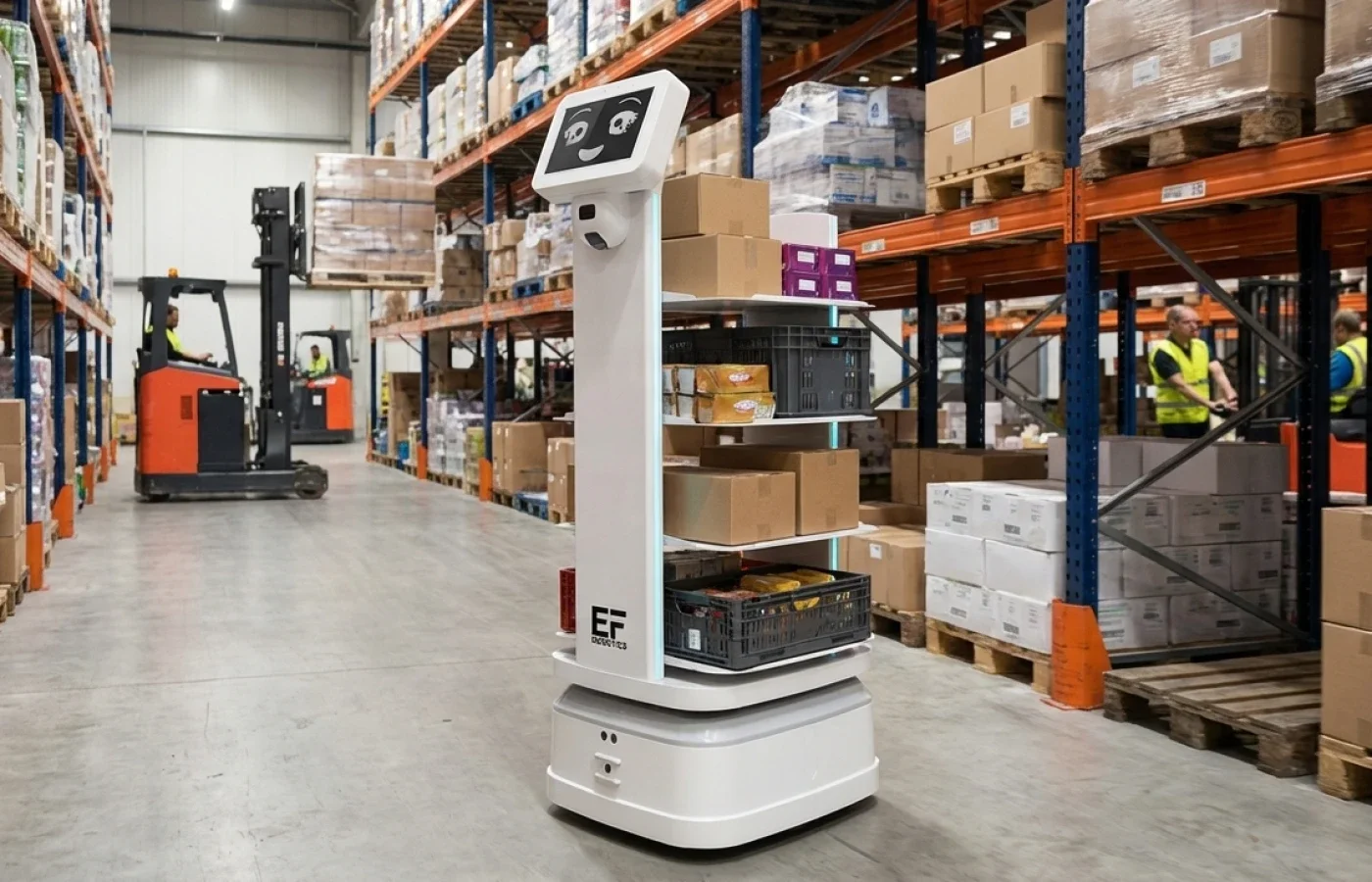
Die Robot programming It's much more than writing code today. It includes the structured analysis of processes, the selection of suitable technologies and consistent compliance with safety standards. Modern methods such as offline programming, automatic program creation, and No‑code approaches shorten project runtimes and make robotics accessible even without a large IT team. AGVs and AMRs perform transport tasks, while industrial robots automate precise manufacturing steps. Decision-makers benefit from shorter downtime, lower costs and a high level of flexibility. EF Robotics stands as a vendor-independent consultant, integrator and Long-term partners ready to plan, program and securely operate your automation processes. Arrange a non-binding Consultationto take the first step towards a more efficient future.
We would be happy to advise you.
Our team has experience using robots in many areas. Make an appointment and we will be happy to advise you.
