Robotics companies in Germany: EF Robotics presented
The article highlights the robotics market in Germany, where around 278,900 industrial robots were operated in 2024. He explains the differences between industrial robots, AGVs and AMRs and shows how robotics increases efficiency and counteracts the shortage of skilled workers. Using a practical example, it is illustrated how EF Robotics optimized a customer's logistics with a combination of AGVs and cobots. Expert tips and technical background on navigation, security and integration help decision makers find the right solution. The conclusion: With EF Robotics as an independent partner, SMEs can use robotics wisely, reduce costs and strengthen their future viability.
The robotics market in Germany: opportunities and challenges
The German economy is at robotics A leader in Europe. According to the World Robotics 2025 Report from the International Federation of Robotics, 2024 was around 278 900 industrial robots used in German plants; this corresponds to around 40 percent of the entire EU inventory. In the same year, German companies installed 27,000 new robots, which represents the second-highest value in history. Despite this strong starting position, the automotive industry weakened — installations fell by 25 percent to 6,900 units. On the other hand, there was growth in the metal sector (+23%) and in the chemical and plastics industries (+71%). This dynamic shows that robotics is not just a question for large corporations: SMEs must rethink their processes in order to remain competitive.
At the same time, the number of providers is growing. In addition to global corporations such as Bosch, KUKA and ABB, specialized SMEs and start-ups are establishing themselves. According to a study, two thirds of manufacturers in Germany are on a robotics segment focused, such as linear axes, articulated robots or driverless transport systems; only a few have a broad portfolio. More than 80 percent of all robotics companies are based in Baden-Württemberg, Bavaria or North Rhine-Westphalia. For buyers and technical decision makers, this means: Market knowledge and careful selection are essential for finding the right solution for your own processes.
The shortage of skilled workers is aggravating the situation. In Germany, the workforce is aging; at the same time, there is a shortage of qualified logistics and production workers. An IFR position paper underlines that robots a key role in overcoming the shortage of skilled workers but comprehensive cultural and organizational adjustment is necessary. Companies must therefore not only invest in technology, but also further develop their structures and competencies. EF Robotics helps you develop sophisticated automation concepts that are not only efficient, but also relieve and qualify your employees.
Basics of the German robotics landscape
Industrial Robots, Collaborative Robots, and Service Robots
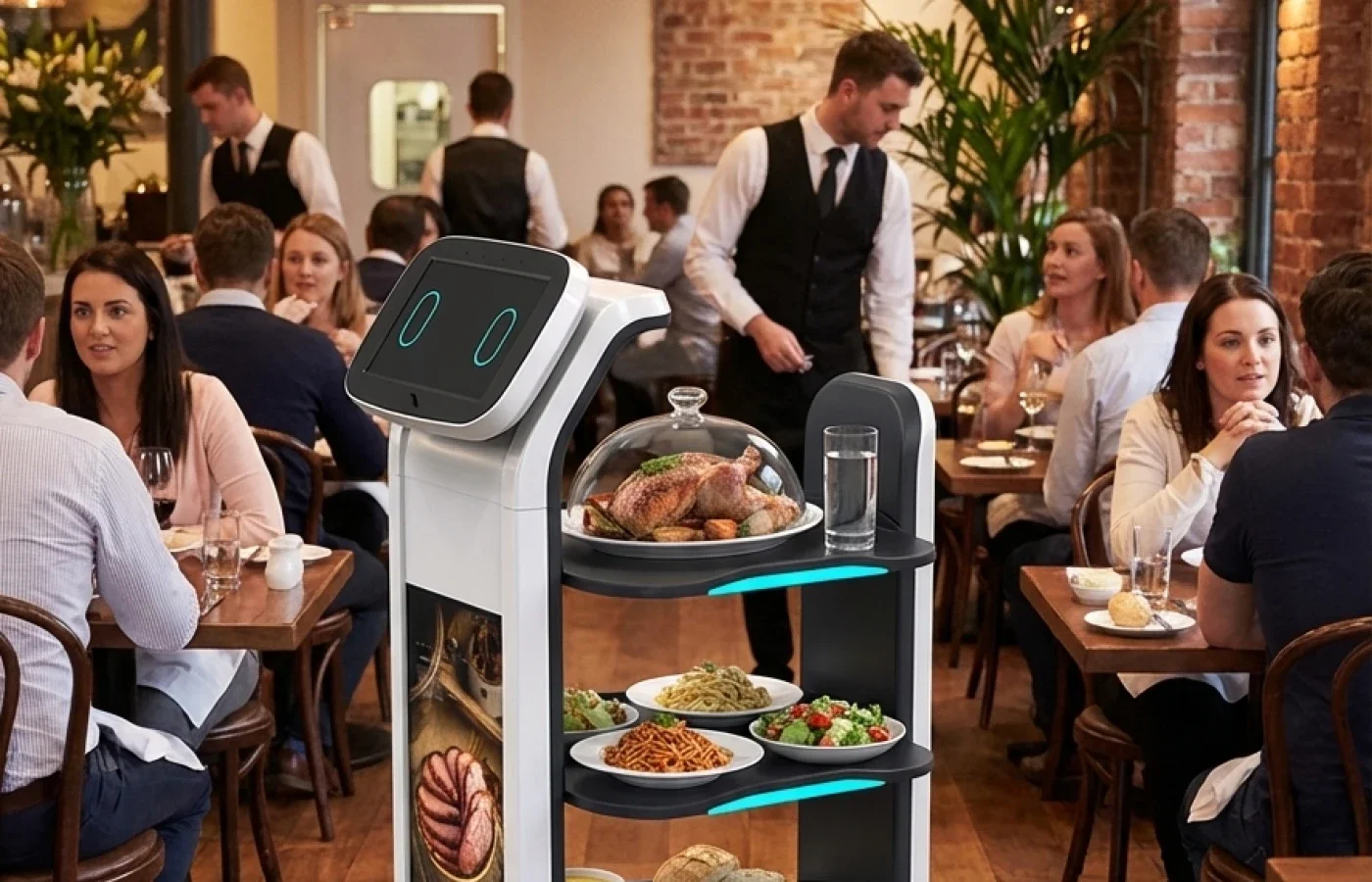
industrial robot are programmable machines that perform repetitive or complex tasks in production. They are typically controlled via six axes and offer high precision. Collaborative robots (Cobots) work right next to people without dividing protective fences. Their built-in security features ensure that they slow down or stop when in contact. Cobots are particularly suitable for flexible assembly tasks and small batch sizes. service robot are designed for non-industrial applications such as cleaning, care or catering; they must be intuitive to operate and move safely in publicly accessible environments.
Driverless transport systems (FTS), AGV and AMR
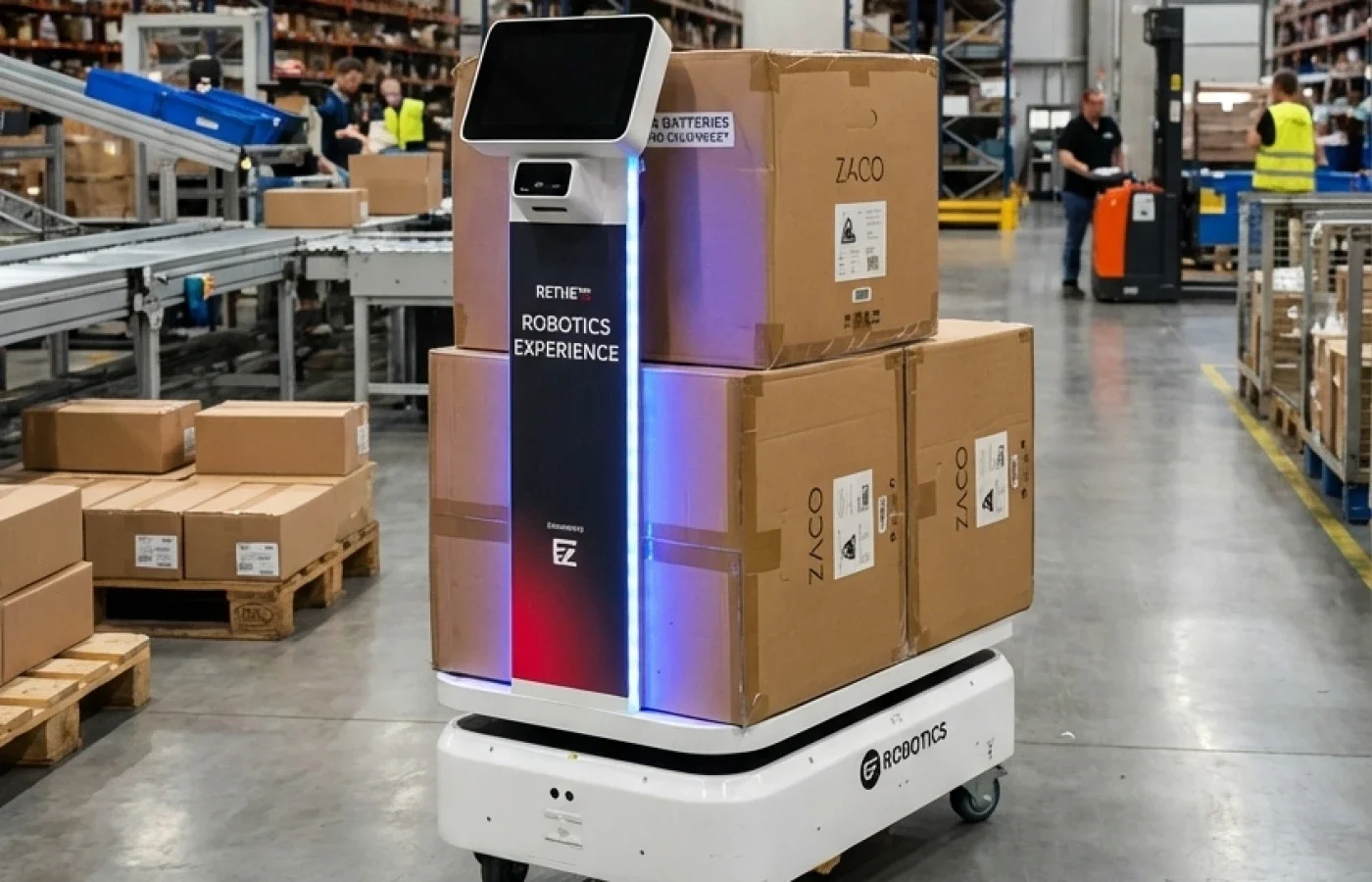
Driverless transport systems (FTS) include driverless vehicles and the associated control system. AGVs are designed for transporting materials indoors and usually follow fixed routes. A Automated Guided Vehicle (AGV) travels on predefined paths that are marked using magnetic strips, lasers or other guidance systems. These vehicles are ideal for recurring transportation in orderly layouts. Autonomous Mobile Robots (AMR) On the other hand, use advanced sensors such as LiDAR, cameras and artificial intelligence to capture and dynamically navigate their environment. AMRs can recognize and avoid obstacles and are therefore suitable for variable environments such as vacant storage areas or areas frequented by people. The choice between AGV and AMR depends on the environment structure, process complexity, and safety requirements.
Humanoid & Collaborative Robotics
In addition to classic industrial robots, humanoid robots that can perform human-like movements are gaining in importance. Manufacturers such as Unitree or Tesla are working on prototypes that could be used in logistics and service. Auch collaborative robotics is not limited to arm robots; mobile cobots combine manipulators with AMR and can perform a wide range of tasks such as picking, sorting or service. For medium-sized companies, it is crucial to use only those technologies that really advance their own use case.
Process optimization vs. automation
Robotics projects should process optimization and automation connect. It is not enough to simply “automate” a process with robots; rather, processes must be analyzed, simplified and standardized. Only then can a robotics solution be fully effective. EF Robotics helps you identify potential and define the right level of automation.
Benefits for decision makers: Why robotics companies?
Efficiency & process reliability
Robots work precisely, repetitively and without fatigue. In driverless transport systems, this means higher throughput and lower error rates. A study by Dematic states that AGVs can be implemented quickly, result in low operating costs and increase productivity. Transport damage and inventory differences can also be reduced because the vehicles travel precisely defined routes. For decision makers, this means that processes are becoming more transparent, predictable and secure.
Relief in case of staff shortages
The use of robotics relieves employees of monotonous or physically demanding tasks. The IFR points out that robots can help to address the shortage of skilled workers, but accompanying measures such as training and organizational adjustments are necessary. Employees can concentrate on value-adding tasks while robots take on routine tasks. Occupational safety is increasing for the workforce and demographic change can be better cushioned.
Cost reduction and scalability
Automation pays for itself through lower personnel costs, lower error rates and higher utilization. AGVs, for example, reduce personnel costs in internal transport because they can work around the clock. AMR can be scaled quickly: New devices can be integrated into existing fleets within a short period of time without the need for structural changes. This gives companies the opportunity to flexibly expand or reduce capacities.
Safety & cleanliness
Modern robots have comprehensive safety features. AGVs are equipped with sensors that detect people or obstacles and stop the journey. Safety standards such as EN ISO 3691‑4 regulate the requirements for mobile robots and ensure reliable operation in mixed work areas. Hygienic designs are crucial for service robots in catering or cleaning; they support compliance with legal requirements and quality standards. For decision makers, this provides legal certainty and a positive impression on customers and employees.
future viability
Investing in robotics creates the basis for scalable and future-proof processes. Digital twins and offline programming make it possible to simulate and optimize new processes before they are implemented in the real plant. Vendors such as Visual Components show that virtual models help to avoid collisions and shorten start-up time. Companies thus increase their speed of innovation and can flexibly adapt to market changes.
Robotics companies in Germany in practice
Designed for a medium-sized logistics service provider from North Rhine-Westphalia EF Robotics a new material flow. The company previously manually supplied a production line with components. The challenge was to supply up to six assembly workstations with different parts at short intervals. These processes required a lot of personnel, and bottlenecks were becoming more and more frequent due to the lack of skilled workers.
challenge
The manual supply required eight employees working in shifts. Running distances of up to 2 kilometers per hour resulted in heavy loads. In addition, there were repeated delays due to the tight time frames. Management was looking for a solution that would relieve existing employees and provide a predictable just-in-time supply ensures.
solution
After a process analysis, EF Robotics selected a combination of AGV and collaborative robots: Four AGVs transport the parts containers along a fixed route. This route was marked with magnetic strips so that the vehicles navigate reliably. The containers are loaded and unloaded by collaborative robots, which pick up the pallets at the assembly stations and provide new containers. Transport orders are generated automatically via an interface to the ERP system.
upshot
With the introduction of the robotics solution, the company was able to significantly reduce transport times and reduce personnel deployment in internal logistics by 50 percent. The employees, who had previously transported goods manually, were transferred to value-adding assembly stations. Process reliability increased because AGVs deliver on time and cobots always deliver consistent quality. Thanks to the scalable fleet, customers can integrate additional vehicles at any time as workload increases. A logistics manager explains: “Thanks to the solution from EF Robotics, we have more time for quality assurance and planning. The robots are intuitive to operate — our team is happy to work with them. ”
Ruwen Prochnow's tips for choosing a robotics company
As a consultant at EF Robotics, Ruwen Prochnow supports numerous automation projects. He underlines: “This is a tip that we always give our customers: First define your process and goals — only then choose the technology. ” Many companies start by purchasing individual robots without thinking through the entire process. This approach often results in inefficient islands and wasted investments. It is better to first analyze all processes, identify bottlenecks and formulate robotics requirements. It is then decided whether AGV, AMR, cobots or stationary robots are the best fit. In addition to technology, employee training also plays a central role: Only those who understand and accept the systems can use them efficiently. EF Robotics supports its customers with workshops, simulations and structured project planning.
Technical perspectives and integration
Navigation and sensors
When choosing mobile robots, navigation concepts and sensors are crucial. AGVs usually use magnetic or color strips, laser reflectors or virtual lines. Their major advantage lies in their high repeatability; they are suitable for clearly structured layouts and simple transport tasks. AMRs combine LiDAR, 3D cameras, and AI algorithms. They are continuously creating maps of their environment and dynamically adapting their path. This flexibility enables use in changing environments, for example when workstations change or people cross paths. Decision-makers should check whether the premises are stable enough for AGV technology or whether the flexibility of an AMR is required.
Safety and standards
When integrating robotics, safety regulations must be met. The norm EN ISO 3691‑4 defines requirements for driverless transport systems, such as braking distances, emergency stop devices and the protection of transfer points. In addition, describes EN ISO 13849‑1 the safety-related parts of control systems, including performance levels (PL a — e). Modern AGVs and AMRs are equipped with safety laser scanners and person recognition, which automatically brake when people approach. Collaborative robots have force-torque sensors that stop the drive in the event of a collision. When choosing a solution, decision makers should evaluate the security features and check whether they address the risk in their application.
Software & Interfaces
A central element of successful robotics projects is Integration into existing IT systems. FTS can be connected to ERP, MES and WMS systems via interfaces. Order data can be transferred automatically; the robots report their status in real time. Modern platforms offer open APIs that enable rapid adaptation to customer-specific processes. In addition, companies should Offline programming and simulation Set. According to Visual Components, robot programming created offline significantly reduces start-up time and increases the use of systems. Digital twins allow processes to be validated and improved in advance.
Modularity and retrofit
Many medium-sized companies have existing conveyor technology or manual workstations. Robotic solutions should therefore be modular and seamlessly integrated into existing structures. AGVs can dock onto conveyor belts or pick up pallets, for example. Cobots can be installed on mobile platforms and used at various stations. By Retrofit Existing machines can be robotized, for example by connecting a collaborative robot to a manual station. EF Robotics develops individual adapters and control concepts so that new technology and existing systems work together smoothly.
Implementation with EF Robotics in detail
Analysis & advice
At the start of a project, EF Robotics carries out a detailed needs analysis: Which processes should be automated? Are there bottlenecks, safety risks, or quality issues? How can a ROI be realistically calculated? In doing so, we not only look at the technical aspects, but also at the effects on your employees. The analysis includes material flows, layout planning, IT infrastructure and legal requirements. On this basis, we create a specification and define clear goals.
Selection of suitable robotics
As a vendor-independent integrator, EF Robotics has access to a broad portfolio of industrial robots, cobots, AGVs, AMRs, autonomous cleaning robots and service robots. Together with you, we select the appropriate technology. In doing so, we take economic efficiency, scalability and sustainability into account. Thanks to our network, we can compare suppliers and test models. When choosing AGVs, we review guidance and charging concepts; with AMRs, we compare different navigation systems; with cobots, we look at safety functions and payload.
Integration into existing processes
Integration is carried out in close coordination with your team. We develop an implementation concept that includes both technical installation and training. AGVs are connected to existing conveyor systems or storage areas. AMRs are integrated into existing IT and controlled via fleet management systems. We integrate cobots into assembly or packaging lines, including safety technology. We carry out the start-up, test all scenarios and optimize the system. Through continuous monitoring, we identify optimization potential and adapt the system to changing requirements.
Start-up, training & service
After the physical installation, it is put into operation. This involves validating routes and gripping movements, carrying out safety tests and testing communication with IT systems. We then train your employees so that they can safely operate the robots and repair minor faults themselves. Our service doesn't end with delivery: EF Robotics offers maintenance contracts, remote support, and regular updates. In this way, we ensure that your systems work reliably for years.
Germany is home to a variety of Robotics companies, which set a wide range of priorities. IFR figures show that Germany operates almost 40 percent of Europe's robots in 2024 and has installed 27,000 new units. At the same time, the focus is shifting from the automotive industry to other industries, meaning that medium-sized companies must rethink their automation strategy. The selection between industrial robots, cobots, AGVs and AMR requires deep process understanding and market knowledge. As a vendor-independent consultant and integrator, EF Robotics is the ideal partner: We analyse your processes, select the appropriate technology, professionally integrate them into your systems and provide you with long-term service and training. In this way, you can tap into efficiency potential, relieve your employees and secure a future-proof position in the competition.
We would be happy to advise you.
Our team has experience using robots in many areas. Make an appointment and we will be happy to advise you.
